Diagnosing and Mitigating Long-Session Degradation
in Full-Duplex Speech Models
Junho Kim1, Che Hyun Lee2, Donghun Kang2, Youngho Cho1,
Dongwook Lee1, Heeseung Kim3,†, Sungroh Yoon1,2,4,†
1IPAI, Seoul National University (SNU)
2Department of ECE, SNU
3Department of AI, University of Seoul
4AIIS, ASRI, INMC, and ISRC, SNU
†Corresponding authors
Abstract
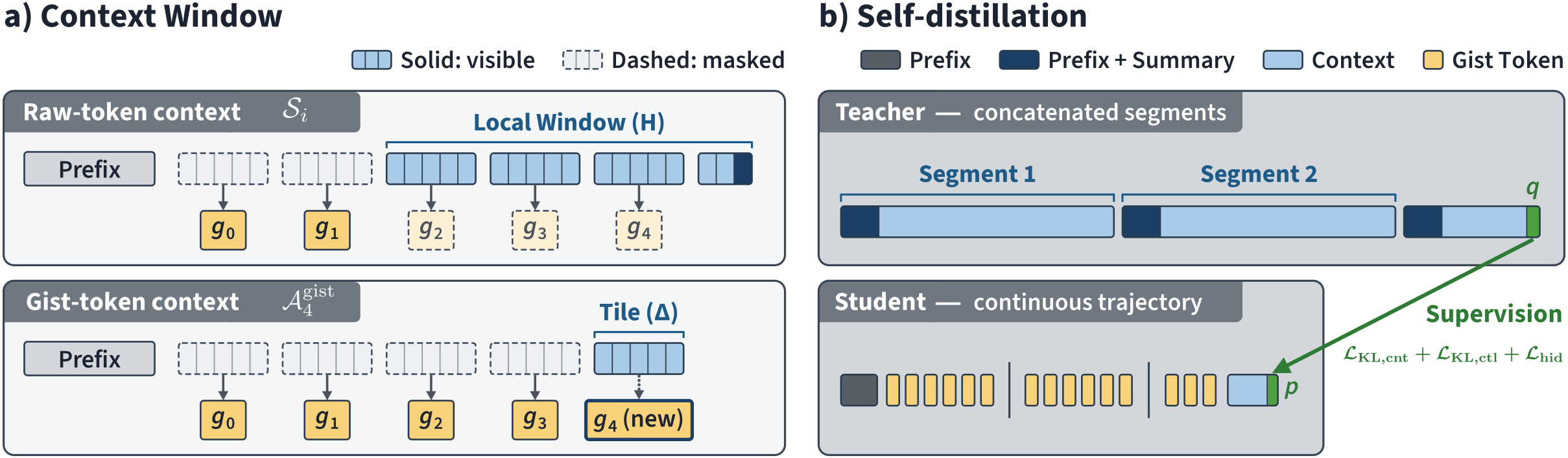
End-to-end full-duplex spoken dialogue models enable natural, real-time spoken interactions with interruptions, backchannels, and overlapping speech. Prior evaluations have assessed diverse interaction capabilities and identified some degradation patterns across conversational turns. However, how model behavior evolves over extended sessions remains insufficiently understood. In this work, we address this gap by systematically characterizing long-session degradation and developing efficient methods to mitigate it. We introduce a closed-loop evaluation framework for long-session stability and apply it to several publicly available full-duplex speech models, revealing degradation over time in responsiveness, spoken content quality, and voice consistency. To mitigate this degradation, we propose a self-distillation-based training framework for lightweight LoRA adaptation that improves long-session stability with a small amount of additional training. We further introduce a two-resolution context (TRC) architecture that preserves recent interactions in full detail while compressing older interaction history into key-value representations. We evaluate our methods on three architectures with distinct formulations of full-duplex conversational context, assessing long-session stability, information retention, and computational efficiency. LoRA adaptation reduces performance degradation over ten-minute sessions across all three models. TRC further extends these improvements beyond the training session length while reducing KV-cache growth by more than 90%.